Elephant Hill wildfire report focuses on the economic impact on culture and well-being alongside resources
May 15, 2023 | 5:03 PM
Aaron Schulze
KAMLOOPS — On July 6, 2017, a wildfire sparked near Elephant Hill just outside of Ashcroft. By the time it was considered under control, the fire had burned more than 1,900 square kilometres of forest and grassland and claimed people’s homes and livelihoods.
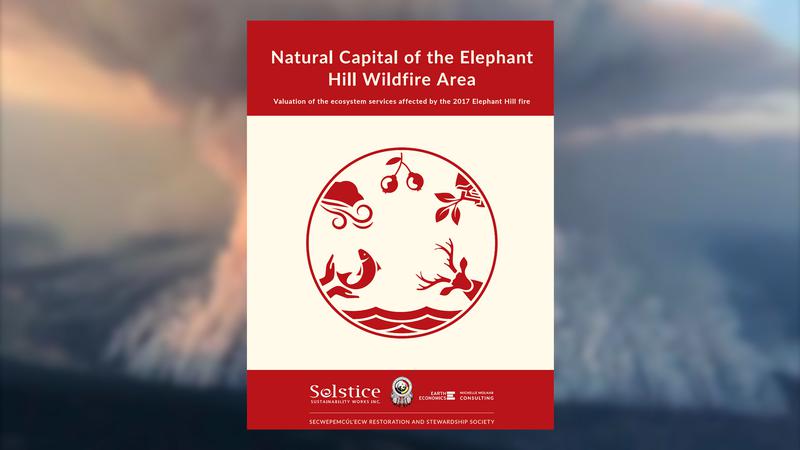
Last week, the Secwepemcùl’ecw Restoration and Stewardship Society (SRSS) released a report on the economic impact of that terrible fire.
“The Indigenous communities who share this traditional territory were impacted in that a way of life was lost,” SRSS CEO Angie Kane explains. “Your wildlife is gone, your plants, your medicines, your food sources are gone. How do we go about putting a value to that way of lie that was lost?”
Enter Susan Todd and Solstice Sustainability Works. Todd specializes in sustainability and has done significant work in natural capital accounting — essentially, putting a value on nature. Todd came up with a number for what was lost as a result of that fire: $1 billion in value per year.
“It is a big number, up to $1 billion dollars in services that nature is providing year in and year out, seemingly for free,” Todd tells CFJC Today.
A large chunk of the value comes from the benefits forests and streams have for water purification and regulation come in at more than $500 million.
However, the benefits people who reside in those areas have lost are significant, as well. Traditional food gathering was pegged at $39 million lost per year, while the loss of culture and well-being comes in at around $26 million.
“We use well-developed ecological economics methods that have been used for decades to look at how you would value something that seems so priceless,” Todd explains. “What does it mean to people to lose those? How does it affect their well-being and their mental health? And what are the healing costs? What is it going to take to recover from that, in terms of healing.”
While $1 billion is a considerable amount of money, the report isn’t all about compensation. The hope is people are able to look beyond that dollar figure at the true value of our wild spaces in BC.
“What we’re really trying to do is highlight the true value of a balanced ecosystem,” Kane says. “Looking to take steps to preserve and protect it I think is our biggest focus around this document. The biggest part of it is identifying or making people aware, so that the right decisions are being made around our forests, or maybe how our forests are managed.”
You can read the full report here.